
Emergency Chimney Sweep Near Me: What Fayetteville Homeowners Should Do First
A chimney fire can burn itself out completely and leave the firebox looking perfectly normal, while the liner behind it has cracked in several places and the framing alongside the chase has quietly charred. “It seemed okay” is how a small chimney fire turns into a house fire weeks later. If something has just gone wrong with your chimney in Fayetteville, the next few decisions matter more than the next few days. Here’s what to do first.
If you’d rather not sort through any of this alone, call (855) 608-7738. We answer 24/7, and we can talk you through the immediate steps before anything is booked.
What should you do in the first five minutes of a chimney fire?
Get everyone out of the house and call 911. That’s the answer for an active chimney fire, and it comes before anything else in this article. A chimney fire roaring up the flue can spread into the attic, the roof framing, or an adjacent wall, and only the fire department can confirm it’s actually out. From outside, look for flames or thick smoke from the top of the chimney, a low rumble like a distant train, or the chimney pipe glowing. Any of those means 911, not a sweep.
What you should not do is close the damper. It’s the most common instinct and usually the wrong one. Shutting the damper starves the fire of air, but it also traps intense heat inside the flue with nowhere to go, and that heat is what cracks liners and ignites framing. On a metal fireplace insert or a factory-built chimney, the same logic applies with even less margin. Get out, call 911, and let the fire department handle the fire itself.
If there’s no active fire but smoke is backing into the room, the flue is likely blocked or badly restricted. That’s a different situation, covered below, and it’s still a stop-use-it-now event.
How do you tell structural damage from surface mess after a smoke event?
After the fire department clears the house, or after a smoke event with no fire at all, you can gather useful information before anyone arrives. You’re looking for signs that the chimney itself has been compromised, not just sooted up. Surface mess is black staining and loose creosote flakes. Structural damage looks different, and it shows up in specific places.
Inside the firebox, check for:
- Cracked or spalled firebrick, especially along the joints and at the back wall
- A warped or buckled metal damper that no longer opens and closes smoothly
- Discolored or heat-scarred metal on an insert or a prefabricated firebox
- Pieces of liner material, tile shards, or chunks of mortar sitting in the firebox
On the exterior, look at the chimney from the ground and from a safe distance, not from the roof:
- New cracks in the masonry crown, or a crown that’s pulling away from the flue
- White staining (efflorescence) on the brick, which points to moisture tracking through
- Loose or missing mortar joints, or brick that’s shifted out of line
- A cap that’s crooked, dented, or gone altogether
Anything on those lists means the chimney shouldn’t be used again until it’s inspected. That’s true whether the damage is visible or not. In Fayetteville’s older masonry chimneys, we often find the inside tells a very different story than the outside, which is exactly why the next section matters.
Why does a confirmed chimney fire require a Level 2 inspection?
A Level 2 inspection is the standard after any confirmed chimney fire, and it’s not the same as a quick look up the flue. It includes a video scan of the entire flue interior, the firebox, the smoke chamber, the damper, the visible exterior, and the accessible portions of the chimney where it passes through the attic and roof. The point is to find what a fire leaves behind, which is often invisible from the firebox.
Specifically, a Level 2 looks for:
- Cracks, gaps, or separations in the clay tile liner or a metal liner
- Failed or missing mortar joints between liner sections
- Damage inside the smoke chamber, the sloped area above the damper
- Charred framing or insulation where the chimney passes through the structure
- A failed crown, cap, or flashing that let water in before or after the fire
A cracked liner is the dangerous one. It lets heat and combustion gases pass directly into the structure of the house, and it won’t show up by looking down the chimney with a flashlight. This is why we treat a Level 2 as a documented service rather than a quick opinion. A chimney inspection should give you a document, not just a verdict. That matters for insurance claims and, if you’re selling or buying a home in Fayetteville, for real-estate clearance.
Where the scan turns up a cracked or deteriorated liner, HeatShield ceramic resurfacing can often restore the flue without tearing out the chimney. Where the flue is offset or the damage is more extensive, a DuraFlex flexible liner is usually the right call. You get an honest recommendation based on what the camera actually shows, not a default upsell.
What’s the protocol after a lightning strike on or near the chimney?
Treat a nearby lightning strike as a possible chimney event even when nothing is visibly burning. Fayetteville sees a lot of summer thunderstorms, and a strike that hits the chimney or the structure nearby can crack masonry, blow apart a chimney cap, or travel down metal components without ever starting a visible fire. The chimney can look fine and still have damage in places you can’t see.
After a lightning event, check these before using the fireplace:
- The chimney cap – Copperfield and Famco caps are built to take weather, but a direct hit can deform or dislodge any cap
- The masonry for new cracks, especially at the crown and the shoulder of the chimney
- Antenna and satellite grounding – a mast strapped near the chimney can carry a strike into the structure
- The firebox for loose bricks or shifted mortar
If anything looks off, don’t light a fire. Call for an inspection. A strike can also expose a pre-existing liner problem the same way a chimney fire does, and the same Level 2 scan answers both questions. We check the cap, the crown, and the flue before anyone recommends repairs.
What does an “emergency sweep” actually include?
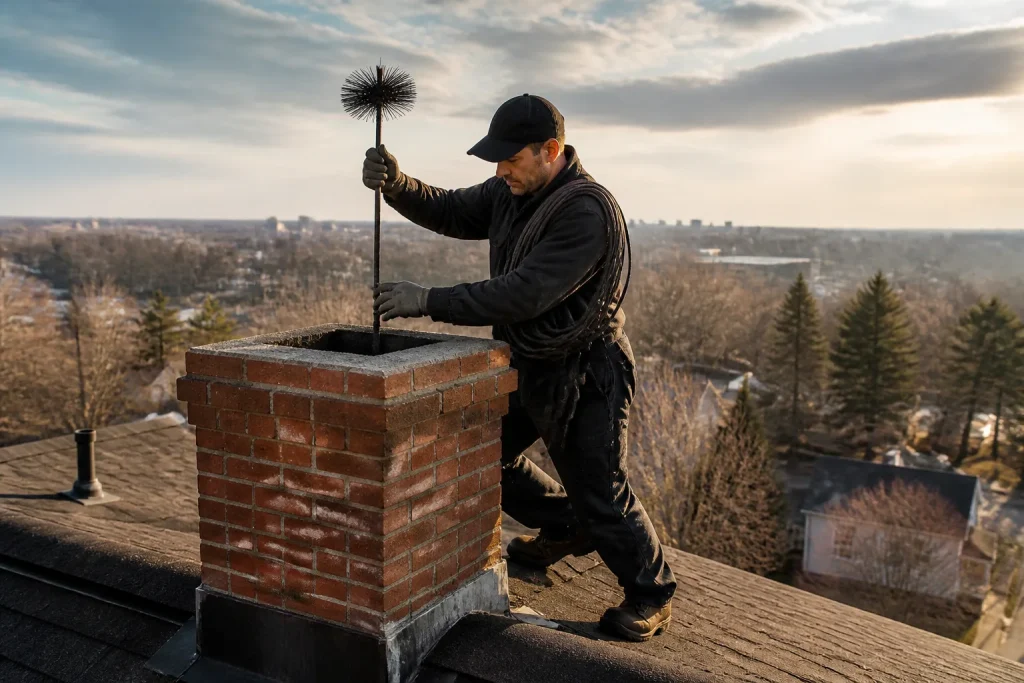
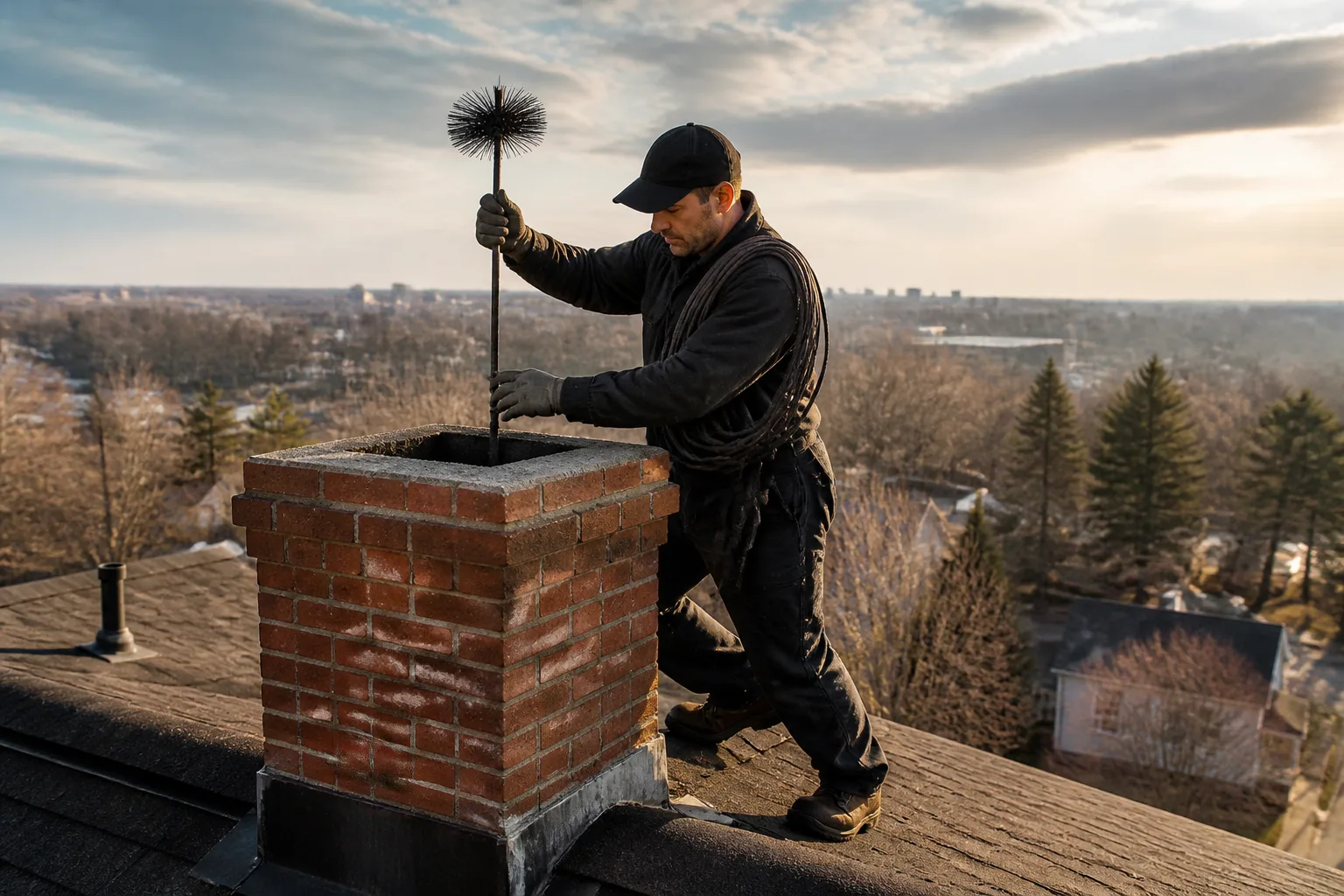
An emergency sweep clears a blockage so you can use the chimney again safely. A post-fire assessment determines whether the chimney is safe to use at all. These are different jobs, and mixing them up is how a real problem gets missed. If your flue is blocked by a bird’s nest, a fallen cap, or a heavy creosote load, a sweep clears it, and you’re back in business. If the chimney has had a fire or a strike, a sweep is not the answer – the flue needs a Level 2 before anything else.
What a sweep involves on a typical job:
- Protect the floor and surrounding area, and set up containment so soot stays in the chimney
- Brush the flue from the top down, with the right brush for the liner type
- Clear the firebox, smoke shelf, and damper area
- Pull the firebox and smoke chamber with a HEPA vacuum
- Show you what came out and what the camera saw inside the flue
We sweep first, assess honestly, and repair only what the flue actually needs. If the camera shows your liner is fine and the creosote was just heavy, we’ll tell you that and send you on your way. If it shows something that can wait until spring, we’ll tell you that too.
When should you call a professional instead of handling it yourself?
Call a professional for anything involving a fire, a lightning strike, a liner crack, a damaged crown, or a flue you can’t see clearly. Sweeping a flue yourself is possible in theory, but the parts that matter – the liner scan, the smoke chamber, the crown, the framing contact points – require equipment and a trained eye. And nothing about a chimney fire is a DIY situation.
Call (855) 608-7738. We answer 24/7, and fast dispatch from 7am to 7pm, Sunday through Friday, means we can usually get a technician out quickly once a visit is booked. Our technicians have up to experience and carry the trade-grade materials the job actually calls for: DuraFlex liners for retrofits, HeatShield for resurfacing, Olympia Chimney components, and Famco and Copperfield caps that hold up to weather. We’re licensed and insured, and estimates are free.
Related services in Fayetteville: if you’re due for routine maintenance, a chimney sweep keeps creosote from building to the point where a fire is likely. If the inspection turns up damage, chimney repair covers liners, crowns, caps, and masonry. And you can learn more about how we work at Delmar Chimney Sweep.
The Bottom Line
If there’s fire, call 911 and get out. Don’t close the damper. After any confirmed chimney fire or lightning strike, don’t use the chimney again until a Level 2 inspection has scanned the entire flue. Separate a sweep from an assessment: an emergency sweep clears a blockage, a Level 2 finds structural damage, and a chimney fire needs the second, not the first. And in Fayetteville’s storm season, a strike that looks harmless is worth checking before you light the next fire.
If you’re in Fayetteville and need help, Delmar Chimney Sweep offers free estimates. Call (855) 608-7738. We answer 24/7, with fast dispatch from 7am to 7pm, Sunday through Friday. We’re licensed and insured, and we’ll show you the camera evidence before recommending any work.
Frequently Asked Questions
An emergency sweep in Fayetteville typically runs in the same range as a standard sweep, and the exact price is set by a free written estimate before anyone starts. We don’t charge a premium for a visit booked on short notice. Call (855) 608-7738 for an exact quote – estimates are free.
Not always. A Level 2 inspection determines whether the liner is actually cracked or deteriorated. Some flues need a full reline with a DuraFlex system; some can be restored with HeatShield resurfacing; and some come through a small fire with the liner intact. We won’t recommend a liner without camera evidence you can see for yourself. Call (855) 608-7738 to book the inspection first – estimates are free.
The standard is once a year for a wood-burning fireplace, or more often if you burn heavily or burn unseasoned wood. A yearly sweep and inspection catches creosote buildup and small liner issues before they become a fire. If you’ve had a chimney fire or a lightning strike, don’t wait for the annual date. Call (855) 608-7738 and get it checked now – estimates are free.
The fire can look out inside the firebox while a cracked liner lets heat and gases into the structure of the house. That’s how a contained fire becomes a house fire weeks later. The inspection is the only way to know whether the flue is intact. Call (855) 608-7738 for a free estimate – the inspection is worth more than the risk of skipping it.
Written by the team at Delmar Chimney Sweep.
Need Chimney Cleaning Help?
Call Delmar Chimney Sweep - licensed & insured, here with fast help in Fayetteville.
(855) 608-7738